Animal Farm Novel Themes That Carry Into The Other Animal Farm
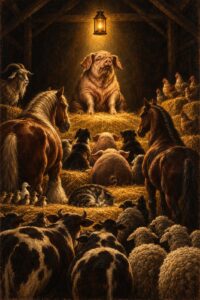
George Orwell’s Animal Farm novel is described in its own publishing material as a scathing satire on a downtrodden society’s blind march towards totalitarianism. Elsewhere it is summed up more bluntly still: the history of a revolution that went wrong. Two sentences, and between them sits almost everything the book does to a reader.
That is the useful starting point for anyone thinking about The Other Animal Farm novel, the forthcoming book from Sleepy Bird Studio by Jordan Moir. A title that borrows so openly from Orwell invites a fair question: which of the original novel’s ideas are strong enough to survive leaving the farm they were built on? Not the plot, not the cast, not Mr. Jones’s Manor. The ideas underneath. What follows is a reader’s map of those ideas, and a look at which ones tend to travel well when a writer picks up the same ground.
The Premise Orwell Sets Up in His Animal Farm Novel
Strip the allegory back and the setup is almost gentle. A group of farm animals rebel against their human farmer, hoping to create a society where the animals can be equal, free, and happy. The struggle is described as bold, and it does something concrete: it transforms Mr. Jones’s Manor. That is a hopeful opening, and it is meant to be. The book needs the reader to want the rebellion to succeed before it can show what happens to that wanting.
Every story that follows in this tradition inherits the same structural gift. There is a before, there is a moment of collective courage, and there is an after that nobody voted for. The gap between those three states is where the drama lives.
Theme One: Power Corrupts the People Who Hold It
The most quoted description of the novel calls it a brilliant satire on the corrupting influence of power. That is not a subtle idea, but Orwell makes it specific rather than abstract. Corruption in the book is not a sudden transformation into villainy. It is a series of small, reasonable-sounding adjustments made by individuals who have convinced themselves they are doing the necessary thing.
This theme carries easily into any successor because it does not depend on pigs or farms. It depends on the ordinary mechanics of any group that gains control of something worth having: a workplace, a committee, a platform, a community. Readers recognise the pattern because they have watched it happen at a much smaller scale.
Theme Two: A Revolution That Goes Wrong
Publishers have been describing the novel as the history of a revolution that went wrong for decades, and the phrase holds because it names the shape of the story rather than its contents. A revolution going wrong is not the same as a revolution failing. Failure is easy to spot. Going wrong is quieter, and it usually happens while everyone is still congratulating themselves.
For a new book working the same territory, this is the hardest theme to inherit honestly. The diagnosis has to be rebuilt from scratch, because the specific ways a movement can drift depend on the specific promises it made. A borrowed warning rings hollow. A warning assembled from the particulars of its own story does not.
Theme Three: The Blind March
The description that does the most work is the one about a downtrodden society’s blind march towards totalitarianism. Note the word blind. The satire is not aimed only at those who seize power. It is aimed at the habits that let power be seized: the willingness to accept a simpler explanation, the reluctance to ask who benefits, the assumption that a shared enemy is the same thing as a shared plan.
Orwell’s novel is also described as a classic satire of the Russian Revolution, which gives the allegory a historical anchor. But the mechanism it examines is not exclusive to that anchor. Any group that swaps one authority for another without changing how authority works has reproduced the same march with new signage.
Theme Four: The Gap Between the Promise and the Result
The animals want equality, freedom, and happiness. Those three words are the promise. What the book documents is the distance between the promise and the outcome, and the strange human talent for adjusting the promise after the fact rather than admitting the outcome.
This is the theme most likely to carry into any new treatment of the same material, because it is the one readers feel personally. Most people have joined something hopeful and watched its language shift. Most people have kept participating anyway, for a while.
Theme Five: Allegory as a Delivery System
The book works as an allegory, and allegory is a delivery system rather than a decoration. Animals standing in for people means the reader absorbs an argument about institutions without feeling lectured by an essay. It also means the story survives translation into other forms. There is a graphic version of the Animal Farm novel, described as the first ever graphic novel version, intended for a young adult and teenage audience, which shows how far the core idea can be carried without losing its shape.
That flexibility matters for anyone approaching The Other Animal Farm novel. A borrowed frame can be a burden or a shortcut. It becomes a shortcut only when the new work commits to its own angle on the same machinery.
The Themes Side by Side
|
Theme |
How the source descriptions frame it |
Why it travels |
|---|---|---|
|
Corrupting power |
A satire on the corrupting influence of power |
It plays out in small, familiar decisions rather than grand villainy |
|
Revolution gone wrong |
The history of a revolution that went wrong |
It describes a shape, not a specific cast, so it can be rebuilt |
|
Blind march |
A downtrodden society’s blind march towards totalitarianism |
It targets the habits of the followers as much as the leaders |
|
Promise versus result |
Animals hoping for a society that is equal, free, and happy |
Readers have felt this gap in their own lives at small scale |
|
Allegory as form |
A satire with roots in the Russian Revolution, adapted into other formats |
The argument arrives through story, so it survives a change of medium |
Where The Other Animal Farm Novel Fits
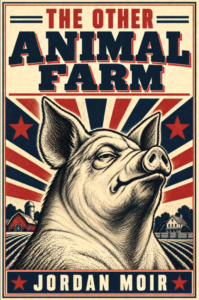
The Other Animal Farm novel is a forthcoming book written by Jordan Moir. That is the limit of what is publicly confirmed, and it is worth being careful about the rest. Release timing, format, and the specifics of the story should be checked with the studio directly rather than assumed from the title.
What the title does offer is a frame for reading. A reader who has just finished Orwell’s novel arrives with a set of expectations already loaded: the corrupting influence of power, the revolution that drifts, the society that trades one authority for another. A book that deliberately echoes another book’s title is inviting that comparison. Sometimes the echo is a continuation, sometimes it is an argument, and sometimes it is a way of asking the reader to notice what has changed in the decades between the two.
The healthiest approach is to hold the themes of the Animal Farm novel as questions rather than a checklist. Does the new book treat power as a temptation or as a system? Does it blame the leaders, the followers, or the conditions that produced both? Does it end in defeat, in accommodation, or somewhere less comfortable? Those are the questions a borrowed title sets up.
Reading Orwell First
Anyone planning to read the new book alongside the original has plenty of editions to choose from. The novel is widely available in a Signet Classic paperback, in an English-language hardcover, and as a Kindle ebook, and there is a combined Animal Farm / 1984 edition for readers who want both novels in one place. The graphic novel adaptation offers a different route in for readers who prefer a visual telling.
Availability, current pricing, and shipping details sit with individual retailers rather than with any single source, so it is worth checking a bookseller directly before ordering. Secondhand and independent bookshop listings are also common for a title this widely printed.
What Carries, and What Has to Be Rebuilt
A theme is not a plot device. It is a question the story keeps asking, and the strength of any successor lies in whether it asks that question with fresh specifics or simply repeats the answer.
The corrupting influence of power carries because it needs no particular setting. The blind march carries because it describes behaviour rather than events. Allegory as a form carries because readers accept arguments more readily when they arrive as animals. What does not carry is the diagnosis. Orwell’s novel earns its ending because the drift is built from the details of its own revolution, and a new book has to earn its own.
That is the honest test of a title like The Other Animal Farm. The themes are available to anyone. The evidence for them has to be gathered again, farm by farm, decision by decision, until the reader recognises the march before the characters do.
