Peering Over the Fence: Why The Other Animal Farm Hits Closer to Home
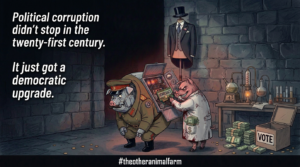
For nearly eighty years, George Orwell’s Animal Farm has stood as the Western world’s favourite cautionary tale about political power. Taught in high school classrooms from London to Sydney to New York, the 1945 novella is universally praised for its sharp wit and moral clarity. Yet, for readers living in liberal democracies, there is a hidden comfort in Orwell’s masterpiece.
Animal Farm targets Stalinist totalitarianism—a political system the Western world has largely rejected. Consequently, reading Animal Farm is a little like peering over a neighbour’s fence. We can shake our heads at the folly of the barnyard animals, condemn the brutality of the pigs, and walk away feeling grateful for our own institutions.
Enter The Other Animal Farm. By taking Orwell’s exact themes—propaganda, class stratification, exploited labour, and the quiet erosion of founding ideals—and transplanting them into a democratic capitalist society, this reimagining strips away that comfortable distance. Instead of letting us gaze across the ideological divide at an external enemy, The Other Animal Farm forces us to turn around and examine our own backyard. For book readers, academics, students, and political thinkers alike, the shift from an authoritarian allegory to a democratic capitalist one transforms a familiar fable into an uncomfortable mirror.
The Comfort of the External Threat
To understand why The Other Animal Farm is so confronting, we need to examine why Orwell’s original became so safe for Western audiences. When Orwell wrote Animal Farm during the Second World War, his goal was to expose the myth of Soviet socialism and warn against the rise of authoritarianism. He succeeded brilliantly. Through the rise of Napoleon, the banishment of Snowball, and the rewriting of the Seven Commandments, Orwell mapped out the exact mechanics of a totalitarian takeover.
During the Cold War, however, Western institutions enthusiastically adopted the book as a tool for anti-communist sentiment. In doing so, they unintentionally defanged its broader warning. When we read Animal Farm through a strictly historical lens, the villains are easy to spot. Tyranny wears the boots of Mr. Jones or walks on two legs like Napoleon. Oppression relies on snarling guard dogs, public confessions, and overt violence.
Modern Western democracies rely on free elections, open markets, and constitutional rights rather than secret police. As a result, it is easy for readers to treat Orwell’s warnings as solved problems. We look at Boxer, the tireless cart-horse who works himself to death under the motto “I will work harder”, and pity him as a victim of state-enforced collectivism. We look at Squealer’s linguistic gymnastics and view them as a uniquely totalitarian brand of state censorship. In short, Animal Farm allows democratic readers to feel morally superior. The rot is over there, on their farm, under their system.
Moving the Allegory into Our Own Backyard
The Other Animal Farm dismantles that sense of security by asking a provocative question: what happens when the pigs don’t need a coup to take over? In a democratic capitalist setting, power rarely announces itself with a show of force. Instead, it operates through market incentives, legal loopholes, media narratives, and the illusion of choice.
By setting the fable inside a system that looks like our own, The Other Animal Farm shows that the core dynamics of Orwell’s barnyard do not require a dictator to thrive. They can flourish within a free society, often with the enthusiastic consent of the animals themselves.
From State Propaganda to Market Spin
In Orwell’s farmyard, Squealer manipulates the animals through fear and outright historical revisionism, sneaking out at night to alter the painted commandments on the barn wall. In a democratic capitalist barnyard, control over the narrative is far more subtle. There is no Ministry of Truth banning dissenting opinions. Instead, information is fragmented, monetized, and spun through public relations.
In The Other Animal Farm, the ruling class doesn’t need to outlaw critical thinking when they can simply overwhelm the animals with distraction, consumer choice, and partisan outrage. When the barn’s resources are ultimately owned by a few, the justification isn’t the glory of the state; it is the inevitability of the market.
The animals are told that those who hold the most grain are, in effect, creating more wealth for all to enjoy, and that any attempt to redistribute the harvest will restrict freedoms and ruin the farm’s productivity for everyone. The language shifts from ideological dogma to corporate jargon, yet the result remains the same: the working animals are convinced to vote against their own material interests.
Boxer in the Gig Economy
Perhaps the sharpest parallel between the two narratives lies in the fate of the working class. In Animal Farm, Boxer is betrayed by a regime that promises equality while extracting every ounce of his physical strength, eventually selling him to the knacker when he is no longer useful. It is a heartbreaking tragedy of state betrayal.
In The Other Animal Farm, Jack (Boxer’s equivalent) doesn’t need a whip or a totalitarian decree to work himself to the bone. He is driven by debt, rising living costs, and the promise of upward mobility. He is told that he is not a labourer, but an entrepreneur of his own time. If he just pulls the plough a little faster, takes on a seconds job, and skips his rest, he too might one day move into the farmhouse.
When his body finally gives out through unexpected injury, there is no dramatic betrayal by a dictator—just a quiet restructuring, a lack of safety nets, and a replacement waiting in line. Looking at Boxer through the democratic capitalist lens that is Jack, forces readers to confront how modern economic pressures can replicate the exact same human toll as authoritarian coercion.
The Illusion of Choice and Political Theatre
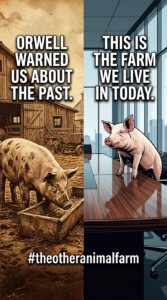 Orwell’s original novella ends with a chilling image: the animals look through the farmhouse window and can no longer tell the pigs from the humans. The revolutionary leaders have become identical to the old masters.
In a democratic capitalist allegory, that moment of realization looks very different. The animals are still allowed to cast ballots, debate in the barn, and choose between different factions of pigs. Yet, behind closed doors, the competing factions dine at the same table, funded by the same wealthy benefactors. The Other Animal Farm highlights how democratic rituals can be hollowed out when economic power translates directly into political influence.
The animals enjoy the freedom to complain, protest, and vote, yet the fundamental structure of the farm never changes. The fence isn’t keeping them in by force; it is maintained by the belief that the system is inherently fair because they had a say in who holds the keys to the feed shed.
Why Literature Needs to Make Us Uncomfortable
For regular readers of political fiction, the contrast between these two versions of the barnyard raises an important question about how we engage with classic literature. George Orwell himself was a committed democratic socialist who spent his life critiquing both Soviet communism and the unchecked inequalities of Western capitalism. He never intended for Animal Farm to be a celebration of the status quo in Britain or America. Yet, over decades of canonical reverence, the book became a comfort blanket for Western democracy.
When a satire becomes too familiar, it loses its bite. We memorize its quotes—“All animals are equal, but some animals are more equal than others”—and deploy them as clever remarks against our political opponents without ever turning the critique inward. The Other Animal Farm restores the shock value that Orwell’s original had in 1945. It refuses to let the reader off the hook.
For political contributors and commentators, this distinction is vital. It is easy to diagnose authoritarianism from afar, to point at censorship, rigged elections, and state violence in foreign regimes and declare them incompatible with our values. It is much harder to examine how censorship occurs through algorithmic suppression, how elections are skewed by lobbying and dark money, and how economic desperation limits freedom just as effectively as a locked gate.
Looking Across the Lawn
Ultimately, Animal Farm and The Other Animal Farm are not rivals; they are companion pieces that illuminate two sides of the same human vulnerability. Orwell’s novella remains an essential warning about what happens when society surrenders its critical faculties to a strongman in exchange for promised security. It teaches us to watch the perimeter, to guard against the sudden seizure of power, and to distrust any leader who claims absolute authority.
The Other Animal Farm, however, reminds us that not all threats come from over the fence. Some grow quietly in the soil beneath our feet. By framing the struggle for equality, truth, and fair labour inside a democratic capitalist system, it challenges us to look closely at the everyday compromises we accept as normal. It asks whether we are truly free, or simply better managed. And for any reader who cares about the health of democracy, taking a long, honest look at our own backyard is the most important work we can do.
To find out more about The Other Animal Farm click here.
