The Other Animal Farm: A Companion to Orwell’s Animal Farm
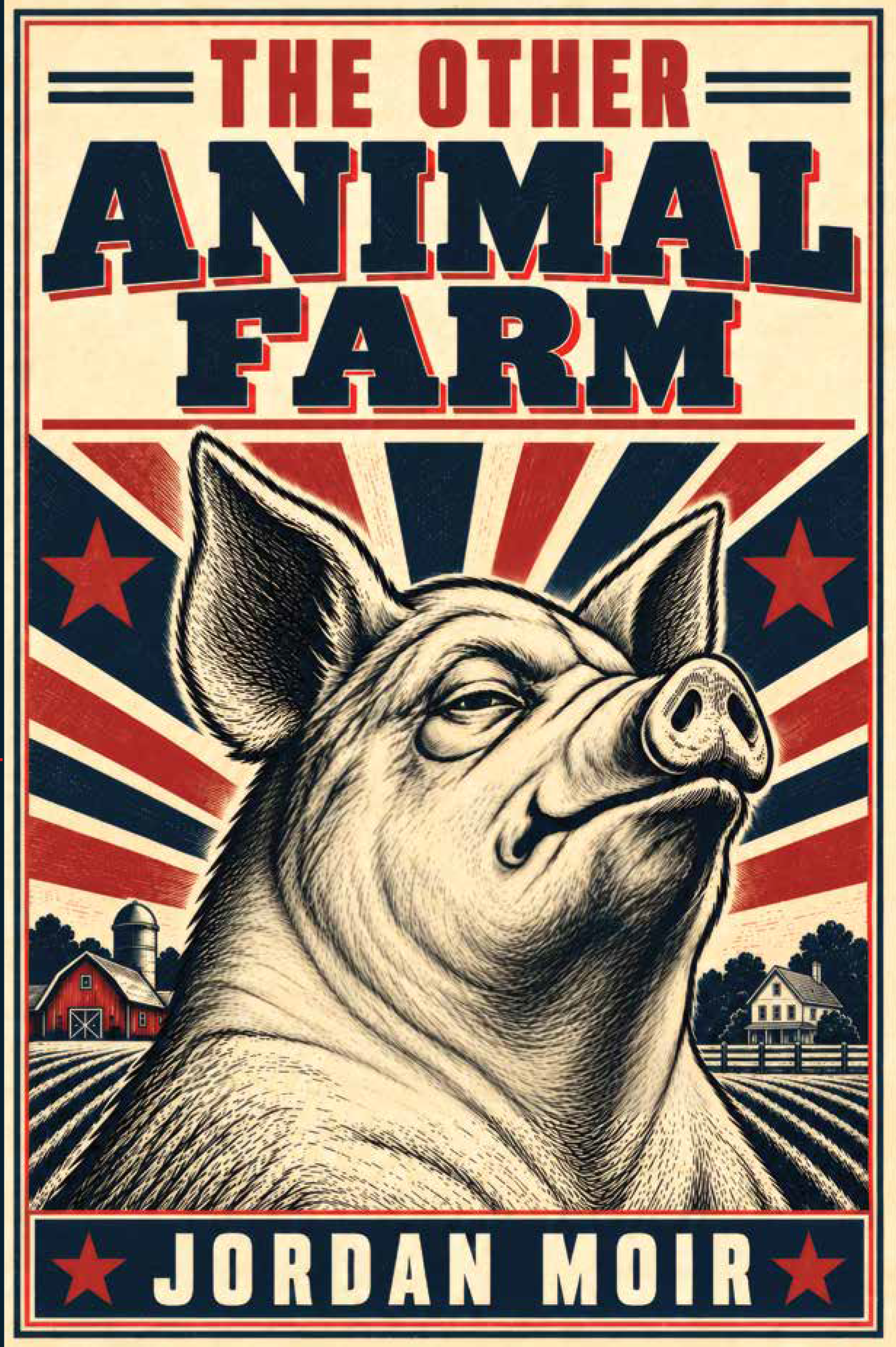
George Orwell’s Animal Farm was published in 1945, and it has never really left the conversation. The novel is a satirical fable about a group of farm animals who rebel against their human farmer in the hope of building a society where the animals can be equal, free and happy. What follows is not that society. The pigs seize power, rewrite the rules, erase truth and crush dissent, and the farm descends into a ruthless dictatorship. It is usually described as an allegory of the 1917 Russian revolution, and readers have found it perpetually applicable ever since.
The Other Animal Farm by Jordan Moir takes that inheritance seriously. It is a companion to Orwell’s novel rather than a retelling, and its organising idea fits into three short lines: a different farm, a different system, the same outcome. This time the setting is a democratic capitalist society. The question the book keeps pressing is whether the failure Orwell described belongs to one particular ideology, or to something more stubborn in the way people organise themselves.
What Animal Farm Does So Well
Orwell’s novel works because it is short, plain and merciless. The animals of Manor Farm begin with a genuine hope, and the reader is allowed to feel how reasonable that hope is. The betrayal arrives in stages, through small adjustments to language, through rules quietly amended, through a growing gap between what is announced and what is true. By the end, the ideals have not been defeated in open battle. They have been edited out of existence.
That structure is why the book has survived so many interpretations. It is taught as political history, read as a warning about propaganda, and quoted whenever a promised reform turns out to benefit the people who promised it. It has also kept being adapted for stage and screen, including a 2025 animated film directed by Andy Serkis that reworked the plot as an allegory for business corruption in the 21st century. Every generation finds a new version of the same farm.
A Different Farm, a Different System
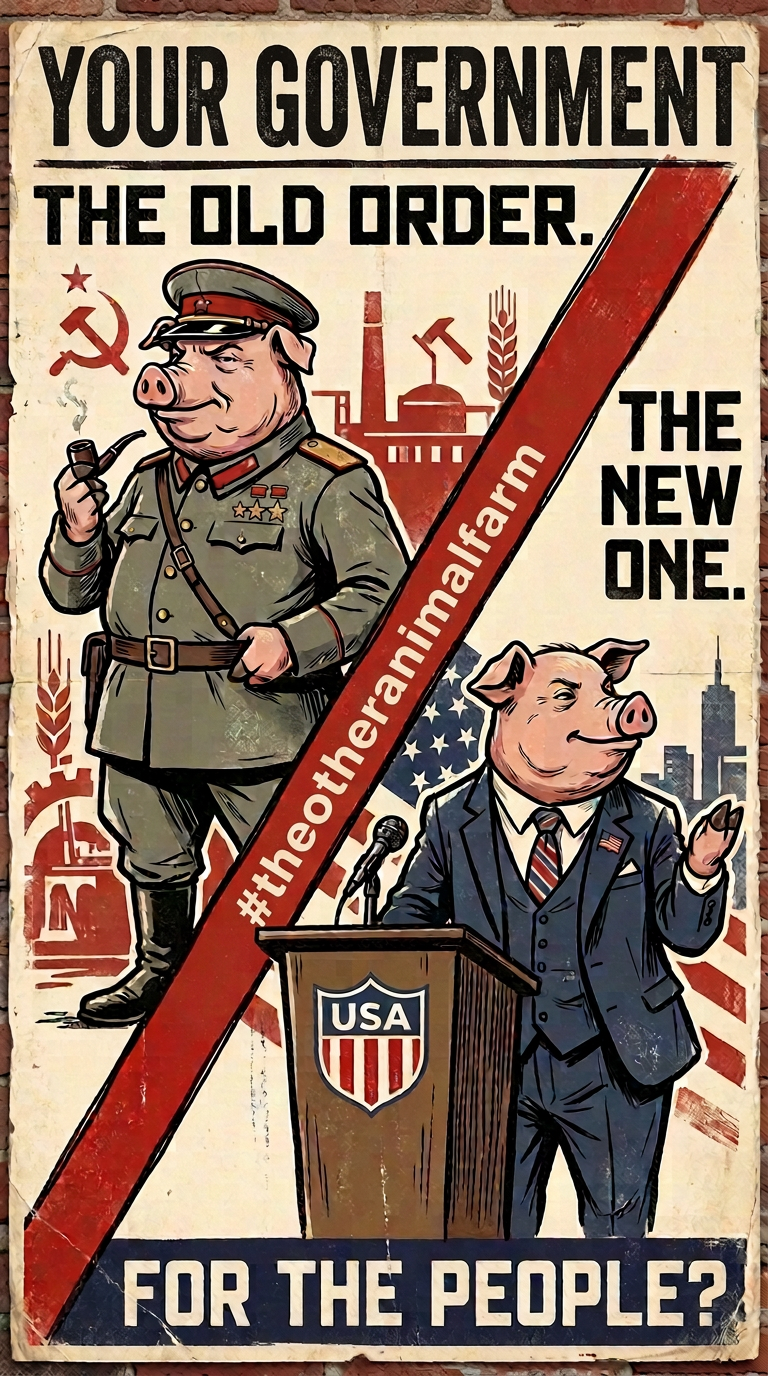
The premise of The Other Animal Farm is that Orwell’s warning does not depend on the animals being revolutionaries or the pigs being commissars. Move the whole arrangement into a democratic capitalist society and the machinery looks different: elections instead of decrees, markets instead of quotas, shareholders instead of a politburo, public relations instead of slogans painted on a barn wall.
The people in that system are not villains in the cartoon sense. They vote, they compete, they respond to incentives, and they mostly believe what they say. That is exactly what makes the book uncomfortable. If the same outcomes can emerge from a system built on choice and competition, then the problem was never only about who was in charge. It is also about how rules get written, who benefits from them, and how easily an ordinary person can be persuaded that the arrangement is fair.
|
Element |
Animal Farm (1945) |
The Other Animal Farm |
|---|---|---|
|
Author |
George Orwell |
Jordan Moir |
|
Setting |
Manor Farm, after an animal revolt |
Hancock Farm, renamed The Untited Fields of Animals (UFA) after the animals declare their independence. |
|
Form |
Satirical fable and anti-utopian satire |
Companion novel exploring the same themes |
|
Central concern |
A revolution’s promise of equality captured by a ruling group |
The same promise tested inside a democratic and capitalist system |
Why the System Swap Matters
A common way to read Animal Farm is as a book about a specific kind of government, safely far away in place and time. That reading lets everyone else off the hook. The Other Animal Farm removes the escape route. It places the same pressures inside an economic and political order that most readers actually live in, and asks them to recognise the pattern without the historical costume.
The recurring ingredients are all familiar. Language bends to serve the people who control it. Rules that look neutral turn out to protect whoever wrote them. Hard work is praised loudly and rewarded quietly. A population that considers itself free keeps agreeing to arrangements it did not fully read. None of that requires a dictator, which is the point. It only requires enough people deciding that the system is basically working and that raising objections is in poor taste.
About Jordan Moir
Jordan Moir writes from the position of someone who has spent a long time studying how organisations behave. He holds a Bachelor of Management, for which he received the Australian Institute of Management Prize for the most outstanding graduate, and an MBA in Innovation and Leadership. He is currently a doctoral candidate in Business Leadership. He has also written a screenplay that was produced as a film, The Samoa Deal.
Away from his studies and his writing, Jordan is a scuba diver with more than one hundred dives behind him, and he has a particular fondness for reptiles and sharks. He is an active member of The Church of Jesus Christ of Latter-day Saints. He has been married for thirty years and is the father of six children and the grandfather of two.
The Household Behind the Book
Politics was a regular topic of conversation in the home where Jordan grew up. His father was a political scientist, left-leaning on matters of economics and more conservative on some social questions, and Jordan was raised on frequent talk about where conservative and liberal ideas part ways, and why thoughtful people end up on both sides.
That upbringing is never far from the pages of The Other Animal Farm. A book about systems is easy to write as a prosecution. A book written by someone who grew up hearing both sides argued in good faith is harder to reduce to a team. The result is a companion that takes the reader’s own instincts seriously, including the instinct to defend an arrangement that has been good to them.
How to Read the Two Books Together
You do not need to read Orwell first, but the pairing rewards it. The original is short enough to finish in an evening, and its plainness is part of the argument. Once the shape of Manor Farm is in your head, the second book has something to push against.
-
Read Animal Farm for the structure, not just the politics. Watch the moments when the rules change and notice how few characters object.
-
Keep a note of every promise made to the animals and track what happens to it. Then do the same with the promises made in the new book.
-
Pay attention to the language. In Orwell’s novel, control arrives through vocabulary. In a democratic capitalist setting, it tends to arrive through branding, jargon and the confident tone of a quarterly announcement.
-
Ask who does the work and who receives the credit. The ordinary labourer is the moral centre of both stories.
-
Finish with the question the pair is really asking: what would have to be true for the outcome to be different?
Who This Book Is For
Readers who studied Animal Farm at school and suspected there was more going on will find a natural next step here. So will people who work inside large organisations and recognise the gap between what is announced and what is actually happening. Business readers may find the book more pointed than they expect, given the author’s background in management and leadership research.
It is not a replacement for Orwell and it does not ask to be. It is a companion, written for readers who want to keep arguing with the original long after the last page and who are willing to see their own system described in the same cold light.
Frequently Asked Questions
Is The Other Animal Farm a sequel to Animal Farm?
No. It is a companion book, not a continuation. George Orwell’s Animal Farm was published in 1945 and ends where it ends. Jordan Moir’s book takes the themes of that novel, including power, rules and the corruption of an ideal, and explores them in a new setting: a democratic capitalist society.
Do I need to read Animal Farm before this one?
It helps, but it is not essential. The Other Animal Farm stands on its own as a story. Readers who know the original will pick up more of the echoes, particularly around rewritten rules and manipulated language, but someone arriving fresh will still follow the argument without preparation.
What is Animal Farm actually about?
Orwell’s novel follows a group of farm animals who overthrow their human farmer, hoping to create a society where the animals can be equal, free and happy. Over time, the pigs seize power, rewrite the rules, erase truth and crush dissent, and the farm becomes a dictatorship. It is a satirical fable usually read as an allegory of the 1917 Russian revolution.
Who is Jordan Moir?
Jordan Moir is the author of The Other Animal Farm. He holds a Bachelor of Management, awarded with the Australian Institute of Management Prize for the most outstanding graduate, and an MBA in Innovation and Leadership. He is a doctoral candidate in Business Leadership, has had a screenplay produced as the film The Samoa Deal, and lives with a long family and a longer dive log.
Why move the story to a democratic capitalist society?
Because it removes the comfortable distance. If a story about a revolutionary dictatorship can be dismissed as a warning about someone else’s system, then the warning travels badly. Placing the same pressures inside a system built on elections, markets and choice asks readers to look at the arrangements they already accept.
The Other Animal Farm does not set out to replace Orwell’s novel or to soften it. It sets out to test whether the pattern he described is really about a flag, an economy or a century, or whether it is about something closer to home. Different farm, different system, same outcome. That is the wager, and it is one worth arguing with.

One Comment
Georgina Skountzos
Can’t wait to get it